


The Private Room — Encrypted Video Chat, No Recording
End-to-end encrypted media stream. TLS 1.3 for signaling. No server-side recording of your conversation. The Private Room is the SalaChat room designed for conversations you don't want anyone outside the two of you to ever access.
Open the Private Room
Most video chat platforms keep some amount of conversation data on their servers, for analytics, for moderation logs, or for the platform's own retention policies. SalaChat doesn't record 1v1 conversations on any room. The Private Room is the page that documents exactly which encryption protocols protect your call, and what stays off our servers.
Encryption isn't a marketing word here. It's a specific set of standards (TLS 1.3, SRTP) implemented in specific ways. Honest is better than impressive.
What is The Private Room?
The Private Room is SalaChat's 1-on-1 video chat with explicit, documented encryption and no-recording guarantees.
Three things are true of every Private Room conversation:
(Secure Real-time Transport Protocol). Video and audio packets are encrypted between your browser and the other person's browser.
All connection-setup traffic between your browser and SalaChat's signaling server is encrypted with the current TLS standard.
No video file, no audio file, no transcript stored on our servers after the call ends.
These three properties run on every SalaChat room, not just the Private Room. The Private Room is the page that explains how they work and what they protect.
The Private Room is one of 12 SalaChat rooms. It's the room where the encryption and no-recording story is explicit.
The Private Room at a Glance
| 🔐 Media encryption | SRTP (Secure Real-time Transport Protocol) |
| 🔒 Signaling encryption | TLS 1.3 |
| 📼 Server-side recording | None |
| 💾 Transcript storage | None |
| ⏱ Match wait | 2-10 seconds (median 2.6s) |
| 💬 Avg conversation | 4 minutes (16× longer than industry) |
| 🛋 Room type | Always 1-on-1, never group |
| 🌍 Translation | 25 languages, real-time, free (captions discarded after call) |
| 🌐 Countries | 121 |
| 📵 App required | No, runs in your browser |
| 🆔 Real name required | No, anonymous accounts work |
| 💰 Cost per chat | 20 coins |
| 🎁 Welcome Bonus | 40-150 coins (by country) + 7 days free check-in |
| 🛡 Safety | AI moderation every 3 seconds (frames discarded after evaluation) |
| ⭐ Best for | Sensitive conversations, confidential discussions |
When Privacy at the Content Layer Actually Matters
"Privacy" splits into several layers. The Anonymous Room covers identity privacy (the other person not seeing who you are). The Private Room covers content privacy (the conversation itself not being stored anywhere). Four specific situations where content privacy is what matters.

You're discussing an unpatented business idea
If you're an entrepreneur and you want to talk through a creative idea with someone in another country, the worry is whether the conversation could be intercepted, leaked, or replayed later. The Private Room makes it more concrete: the media stream is E2E encrypted between the two of you, and SalaChat doesn't keep a copy. Whatever you discuss exists only in your two memories after the call.
You're talking to a mentor about something you can't share publicly
A career struggle, a moral question, a personal situation. Mentors and trusted advisors are valuable precisely because you can talk about things you can't say to your social circle. The Private Room is designed so the conversation doesn't leave a trace beyond what the two of you remember.

You're a journalist, researcher, or professional needing source confidentiality
If you're talking with a source or a research subject who needs confidentiality, the Private Room is appropriate. Sources can choose to share what they want, with no server-side artifact remaining after the conversation. Note: for high-stakes professional confidentiality (legal, medical, journalism with whistleblowers), we recommend dedicated tools designed for those specific use cases, not consumer video chat.
You just don't want platforms holding your conversation data
Some users have a baseline preference for not leaving conversation artifacts on platforms. They don't have a specific threat in mind. They just prefer that their conversations not be stored, indexed, or potentially exposed later. The Private Room is built for that preference.
How Encryption Works in the Private Room
There are five distinct layers in how SalaChat protects a Private Room conversation. Each does a specific job.
Layer 1: TLS 1.3 for signaling (between your browser and SalaChat)
Before the call connects, your browser exchanges connection setup information with SalaChat's signaling server. This includes things like "I want to start a call" and "here's how to reach me." All this signaling traffic is encrypted using TLS 1.3, the current industry standard for HTTPS connections.
Layer 2: SRTP for media (between your browser and the other person's)
Once the call is established, your video and audio are sent as a media stream. The stream is encrypted using SRTP, Secure Real-time Transport Protocol. SRTP is the standard for encrypted real-time media and is the same protocol used by Google Meet, Discord, and other mainstream video chat services.
Layer 3: Key exchange via DTLS
The encryption keys for the SRTP media stream are exchanged using DTLS (Datagram Transport Layer Security), which derives keys negotiated between the two browsers directly. SalaChat's signaling server facilitates this exchange but doesn't see the resulting media keys.
Layer 4: SalaChat servers route signaling, not media
For most calls, the media flows peer-to-peer between the two browsers without passing through SalaChat's servers. For calls where peer-to-peer isn't possible (due to NAT or firewall restrictions), the media is routed through a SalaChat TURN server, but the encryption keys stay between the browsers, so the relay server doesn't see decrypted content.
Layer 5: No server-side persistence of media content
Even when media briefly transits a SalaChat TURN server (in cases requiring relay), nothing is written to disk. The packets are forwarded in real time and not retained. After the call ends, no media artifact exists on SalaChat's infrastructure.
Each Private Room chat costs 20 coins, the same as every other SalaChat 1v1 room. New users get a Welcome Bonus from the Host (40-150 coins by country) plus 7 days of free daily check-in. For Tier 1 countries, about 360 free coins your first week, around 18 private chats at no cost.
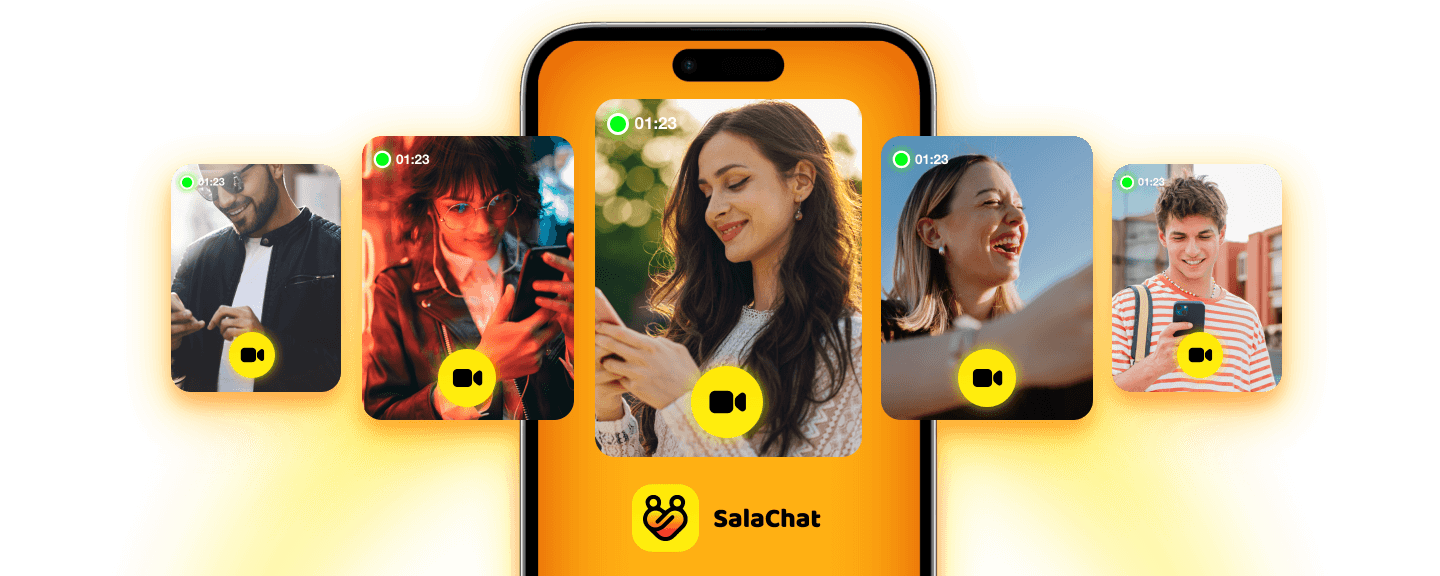
What We Don't Store
The most important property of the Private Room is the list of things SalaChat does not keep on its servers after a conversation ends.
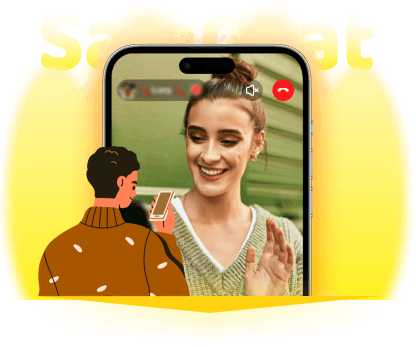
We don't store video recordings
No video file is written to SalaChat's storage during or after a Private Room conversation. The video stream is forwarded in real time (peer-to-peer or via relay) and discarded as soon as it's delivered.
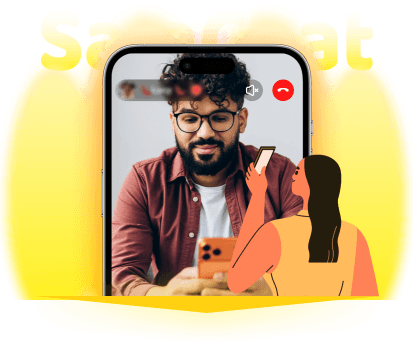
We don't store audio recordings
The same applies to audio. No audio file persists on SalaChat infrastructure after the call. The audio is encrypted, streamed, and gone.
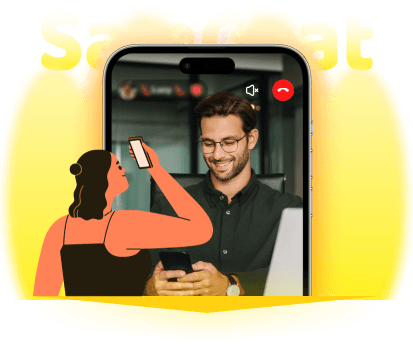
We don't store conversation transcripts
The Translation Room's captions stream during the call and disappear when the call ends. The Private Room (which can also use translation if you choose) handles captions the same way: rendered live, never written to a database or log file.
AI moderation evaluates frames without persisting them
The AI moderation system samples frames every 3 seconds to check for community guideline violations. The sampled frames are evaluated in memory and discarded immediately. The system stores the signal (violation or no violation) for safety enforcement, but not the underlying frame.
What Encryption Can't Protect
End-to-end encryption is strong but it isn't magic. Being honest about the limits matters more than overselling.

Encryption doesn't prevent the other person from screen-recording
If the other person uses their phone's or computer's built-in screen recording feature, they capture the call from their end. SalaChat can't technically prevent this because the recording happens after the video is decrypted on their device. Our terms forbid it, and we ban users who do it when reported, but we can't make it impossible.
Encryption doesn't help if you reveal sensitive information verbally
If you say a password, share an account number, or describe your home address out loud during the conversation, that information is now in the other person's head. Encryption protects against external eavesdropping, not against what you choose to share with the person you're talking to.
Encryption doesn't prevent SalaChat from knowing who you are
You signed up with an account. We have your sign-in credentials. We don't share this with the other person, and we don't store the conversation content, but we know you exist as a user. If you need full anonymity against SalaChat itself, no consumer platform can provide that.
Encryption doesn't protect compromised devices
If your phone, computer, or browser is compromised by malware, the attacker can capture the video before it's encrypted (on your side) or after it's decrypted (on the other person's side). SalaChat's encryption protects the network path, not the endpoints.
Even on SalaChat's other room formats, the same encryption layers apply. Wall and Livcam features, which would be broadcast on other platforms, stay 1-on-1 on SalaChat with the same SRTP media encryption and TLS 1.3 signaling.
Open Your First Private Room
The Private Room takes the same time to enter as any other SalaChat room. Three steps. Encryption runs automatically.
FAQs
Q1: What does "end-to-end encryption" actually mean for a SalaChat call?
Q2: How is this different from regular HTTPS encryption?
Q3: What can you do if the other person records the conversation on their device?
Q4: Do I need to enter my real name to use the Private Room?
Q5: Will any text chat history from the Private Room be saved?
Q6: Is SalaChat free? How do coins work?
Every new account receives a Welcome Bonus from the Host:
🇪🇺 Europe + most Middle East: 150 coins
🇪🇬 Egypt: 120 coins
🇸🇦 Saudi Arabia: 100 coins
🌐 All other countries: 40 coins
Plus 7 days of free daily check-in (20-30 coins per day, up to 210 more free coins).
For users in 44 countries including the UK, US, France, Germany, Italy, Spain, UAE, and the Gulf states, that's about 360 free coins in your first week. Enough for around 18 video conversations at no cost.
Each chat costs 20 coins, regardless of length. After your free first week, you can buy coin packs (no subscription, coins never expire) or upgrade to VIP. Real-time translation in 25 languages is always free. See the full coin breakdown and VIP tiers on the Free Coins page.
Q7: How is The Private Room different from other SalaChat rooms?
Q8: Is The Private Room a dating room?
Open a Private Room Right Now
End-to-end encrypted via SRTP. TLS 1.3 signaling. No recording. The conversation exists only between the two of you, in the moment, and afterward only in what you both remember.
Open the Private RoomE2E encrypted | No recording | TLS 1.3 + SRTP.
🛋️ Your first round is on us.